Showing posts with label Assessment/Evaluation. Show all posts

Wednesday, August 20, 2014

Soils in the Environment Learning Goal Statements and Assessment Strategies (New Product! Plus the Boost Sale)

 My newest product is in my TPT store and just in time for the BOOST Back to School Sale!

Here in Ontario we study Soils in the Environment as part of the Grade 3 curriculum. I know a lot of my American teacher/blogger friends teach about soils as well because I've seen so many great posts, pinned wonderful ideas on Pinterest and purchased your products on TPT! 


This product  is a great companion to your soils unit.
It contains: 

- all of the Big Ideas related to Soils and the Environment from the Ontario Science Curriculum


- the specific expectations re-written in student-friendly language as "I can..." statements. These can be posted on a bulletin board or in your room as you teach through the unit. 


- Individual Student Learning Goal Statement Cards that can be glued into a science notebook or used with the Learning Goal Reflection sheets that are included in this pack


- three different Learning Goal Reflection pages (2 are pictured here)
- Written Learning Goal Reflection, Glow and Grow and Postcards for Learning- lots of different ways to differentiate and help your students self-assess in Science


If you haven't already checked out my Growth and Changes in Plants Learning Goals Pack click here to check it out!

Click on the image to head straight to my TPT store.

Right now this new product, as well as everything else is on sale in my store for the BOOST Back to School Sale.

Don't forget to use the promo code BOOST to get all the deals!


Thursday, July 17, 2014

Chapter 8- Assessment in Guided Math


Another chapter that I didn't post on the first time around! Fun!


I am amazed at how comfortable I have become with assessment in the last few years. I'm not sure if it has to do with the principal I was working for a few years ago or the fact that I now have about ten years of teaching under my belt but I know that I feel confident using anecdotals and observations for assessment where I didn't in the past. 

I love the analogy that Laney Sammons makes on page 227 to the inuksuit in the tundra...assessment as a guide post!
Amazing.

She states "without this guidance [of assessment], the effectiveness of instruction is lost."
Wow.

Some other quotes that stood out for me are:

"When this evidence of student learning [meaning the gathering of data done my teachers- formally or informally] is used to develop teaching practices and enhance learning, assessment is being performed." (page 228)

"Teachers plan, teach, assess learning, and then adjust their instruction. Eventually teachers may even be able to assess and adjust as they teach." (page 229)

This is where I feel I am... sometimes!
And when it happens isn't it a great feeling?

"Students improve their performances and increase their learning when they know precisely what they have done well and exactly what they need to do to improve, and then are given opportunities to do so." (page 229)

I have totally seen this in my own class as there as been such a big push for using success criteria is every subject over the past few years. Co-creating the success criteria, keeping it posted and having students self assess has changed the way students view their own grades.

Something I want to improve is my descriptive feedback and my use of checklists to inform parents of their child's progress on a more regular basis.

On page 234, Sammons writes about using checklists for assessment, something I have grown to really like. She states that "[a]fter the checklist has been completed for a piece of student work, the student is then given an opportunity to revise his or her work so that it meets the criteria."

Yes.
Yes.
Yes.

I LOVE the criteria for problem solving rubric that is shared on pages 236-237 and will definitely be using that in my class this year!

A goal for me this coming year is to involve my students as much as possible in the assessment process and have them self-assess and set goals. This isn't something I've been very good at in the past and I really want to improve in this area.


I try to use lots of different kinds of assessment in my class and in the past years I have found myself using formative assessment quite a lot (yeah me!) as well as anecdotal observations and conferences/interviews.

Here are some posts I've done in the past on assessment:

Talking Pictures- love this for formative/diagnostic assessment
Glow and Grow- a strategy I learned at a workshop and then was expanded on by the amazing Jen from Runde's Room!

(it is actually only one post! LOL...looks like I need to finish that up! OOPS)

Well, it looks like we are almost done our time together for this book study...one more chapter to go.
But don't forget about the Guided Math Conferences Book Study that has started.


Sunday, April 6, 2014

Growth and Changes in Plants- Learning Goal Cards and Assessment Strategies

I have a great new product for you all in my TPT store. It's the biggest product I've made yet and I'm pretty excited about it.

Here in Ontario we study Growth and Changes in Plants as part of the Grade 3 curriculum. I know a lot of my American teacher/blogger friends teach about plants as well because I've seen so many great posts, pinned wonderful ideas on Pinterest and purchased your products on TPT! 


So really this product is for everyone!


If you click on the image below you will see an outline of what this resource contains...and I've included a picture of each item in this post so keep reading!


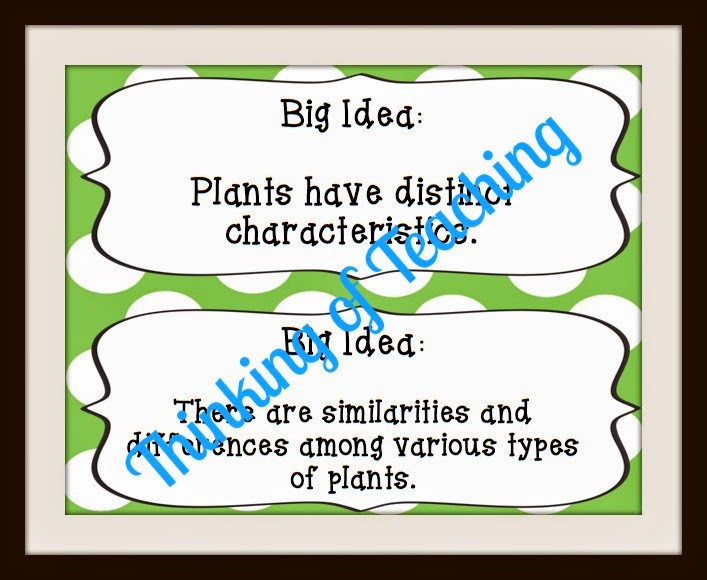
First up, we have the Big Ideas about Growth and Changes in Plants. These can all be displayed at the beginning of a unit or as you move through the Big Ideas. 

I also think it would make a great review task at the end of your unit to have your students sort the Specific Expectation under the Big Idea headings where they fit the best. 


I designed this poster to go on the bulletin board where the learning goals will be displayed. 

There are many different ways to use the learning goal cards. They can be used to display the goal of the current lesson or as an accumulation of the goals you have covered already. 


Below is an example of the learning goal cards. Each one as been paraphrased from the Ontario Curriculum so it is more student-friendly. I have also included the number that correlates with the specific expectation as they are found in the Ontario curriculum.

**NON-ONTARIO TEACHERS:  If you are interested in these learning goal cards but do not want the number that correlates with the Ontario Curriculum, please contact me. I can make a set without the numbers if there is any interest in that!**


Also included in this pack are individual copies of each of the learning goals. These can glued into your student's notebooks to identify the learning goal of a note or activity. They can be used as prompts for a Science Journal or with the assessment tasks that are also in the pack! (Yes, there is more!!)


I have included three of my favourite self-assessment tasks in this pack. The best past is that they can be used with any Science curriculum...so you will get a tonne of use out of these, year after year.

Click on each of the images below to see the assessment task up close. 


Well, I hope you are as excited as I am about this Growth and Changes in Plants "I can..." Big Ideas and Learning Statements Pack. 

Please click on the image below to head over to my TPT store to buy your copy!


I am already working on a similar package for the other 3 Science Units in the Grade 3 curriculum as well as the other subject areas. If you like what you see and would like a specific curriculum set of learning goals to be created please contact me!

Tuesday, October 1, 2013

Interactive Reading Portfolio (Freebie)

This is an oldie but a goodie! This post has by far the highest traffic of all the posts on my blog and I am so happy that so many people have found it useful.

I would like to do an updated version but would love some input. Please take a moment to fill out the short survey at the bottom of the post to help me create a new freebie for you all!

At the end of our Literature Circles unit I was looking for something to celebrate the work my students had been doing and to showcase their skills...so I created a Literature Circles Portfolio (foldable extravaganza)! Throughout the unit we focused on summarizing, making connections, character traits and explain our opinions about a book so of course, that's what the portfolio highlighted. Here are some pictures of my template, completed student work and a few annotations sprinkled in! Enjoy!

Note: This post is very picture heavy! Sorry.


The cover template.

Inside the template...all the foldables closed. I gave my students the option to put their own titles on everything except the connections foldable.

Book Review

Accordion fold summary- we focused on the characteristics of narrative writing during this unit. The foldable outlines the beginning, middle and end of their novel as well and the problem/solution. I am very glad that we did this unit before writing our narratives as I think it really helped my Grade 4's understand the parts of a narrative they were expected to include in their own writing.

Favourite part and favourite character.


Predictions...before and after reading.

Student covers...so well done!


The completed portfolios.


This student went ABOVE AND BEYOND! On the back of the portfolio I gave the students a variety of options...a letter to a character, a poster, party planning etc and gave very little guidance in order to see which students would really take their portfolio to the next level. The inside work was all scaffolded during out Literature Circles unit and so I hoped the back would be an opportunity for students onto apply their knowledge of the book and independently display their learning.

As with all projects, some were great...some, well? Needed more effort, that's to be sure.


As you can see, each student personalized the inside of the portfolio according to their book.


Another great independent project on the back of the portfolio. 


If you are interested in seeing the handout I used for this assignment, along with the rubric, please click here! Also, please note that the independent assignments were not created by me because I found a FABULOUS resource on the web and used a few ideas from there. The link is posted on the handout but you can also check it out by going here.

I hope this helpful and useful for some of you. I would also LOVE to hear about the kinds of projects you use in your classes to celebrate the end of a reading unit. Please post your ideas and comments below. 

Help me create a new Interactive Reading Portfolio Freebie!
Click on the image below to be taken to the BRIEF survey.


Thursday, February 28, 2013

A Look into Our Literacy Workshop


So many things have been going on in our Literacy Workshop classes...we are just a whirlwind of activity these days!!


This is the first anchor chart/activity we did for inferring. We read "The Little Red Pen" and inferred the character's traits based on their actions and words.


We are also working on answering reading comprehension questions using evidence and details to support our ideas. The Grade 3's in Ontario all write a standardized test in the spring and this is part of the process in getting them ready. I cut up four possible answers (an A, B, C and D graded answer) and then had the students decide what grade each answer should get. You can see the votes for each question on the right hand side, with the actual mark being highlighted in orange. It provided some great discussion as the students really had to give a reason for their grades and we took some time to dive deeper into what makes a B a B and an A an A!!


We are working on narrative writing and so...we had a funeral for said! I was very surprised by the amount of coaching my students needed for this! It took a lot of time to coax the ideas out of them and even then some really struggled with giving a different way of saying "said"...something to come back to for sure. 


This is our narrative writing anchor chart. The small paper you can see to the right is a sample story that we colour coded according to the 4 elements on the chart.


We have been continuing with our Book of the Week, but a lot of the work has shifted to the students. We are no longer working in small groups and answering orally but working towards writing our answers out on paper. A big jump for some of my little 3's.


Here is some great predicting/inferring my students have been doing as well! I was so proud with how much they came up with before we even read the book. Just from the cover and the title. 


Here's the beginning of our chart showing how we add our evidence to our schema to create an inference. For this we used the book "No, David!" (always a favourite!). The rest of the chart will be filled in by the students in small groups which I will then assess to see where we are and how much more teaching is needed. From there I will be moving into more independent inferring activities in order to assess this reading skill. 


Whew!! And that's that.

What are you working on in literacy?
Have any great inferring lessons/activities I should try?
What are some great picture books for inferring??

Sunday, January 20, 2013

Writing a Recount-Assessing Student Writing (Freebie)

My students and I have been working on writing recounts for awhile now. We first looked at examples of the text form, I modelled it in class, we practiced completing our planning organizers and have finally gotten to the final step of writing independent recounts! Whew. 

As I was marking my student's work in preparation for our first reports (yikes!) I thought that some of you might be interested in how I assess student writing. I am always looking for new ways to assess student work in order to provide feedback that will help my students improve their work. 

The first step in writing our recounts was to complete the graphic organizer that helps us to plan our ideas.


Click on the image above to download your FREEBIE recount plan. I always resize the page onto ledger (14" x 17") when I copy it for my students so they have enough room to write.


This is an example of a complete recount plan. Once the students have complete the plan to their satisfaction then we have a conference to discuss their plan and to ensure they understand the next steps.

During this unit we started working on looking for places to add extra details into our writing as we moved from a plan to written sentences/paragraphs. To help guide my students in this area I highlighted a few places on their plan where I wanted them to add more details. You can see the highlighted areas in the picture above. 

I know it's difficult to read...but keep going! 

I have a closeup further down in the post. 


Here is an example of my student's complete good copy. Once they had written their ideas out in sentences/paragraphs I gave them a highlighter and asked them to go back and highlight the areas where they added the extra details I asked for. 

This way they are able to see where they improved their work, I can see that they understand this skill and I can easily match up their plan and writing when assessing their work. 


The close-up! 
I asked this student to elaborate on their idea of opening presents and playing with them (obviously a recount about the recent winter break!). 


Here is the highlighted good copy. You can see where the student has added details about her own present, her brother and sister's presents and the time frame in which they played with them.
So impressed!

Now, how do I assess?

Last year I started assessing the majority of my student's work using the four achievement categories outlined in the Ontario Curriculum- Knowledge and Understanding (K), Communication (C), Application (A) and Thinking (T). 


I have found that this really enables me to know a lot of information about my student's abilities and provide a wide range of feedback. 

As I mark I keep quick anecdotal records of the areas of strengths and next steps for improvement. This way I have a record of my own feedback and am able to provide individual comments on my upcoming reports. 


As you can see above, I've left some feedback on my student's writing about what I would like them to work on next time. I also record this in my anecdotal records book. Not a great picture but you get the idea.


When I hand this work back to my students I am going to ask them to read carefully through my feedback and to make some goals for Term 2. In order to do this I am going to use the Glow and Grow strategy I learned about last year.

I first posted about it here.

Then the amazing Jen over at Runde's Room took the idea and just ran with it! I love what she came up with

Now that I am teaching Grade 3 (primary students in Ontario) I am going to adapt the strategy a little bit more. 


Here's what I plan to use with my students to have them reflect on their own work of writing a recount. 
And here is a blank one so that you can customize it for your own class/assignment! Click on either image to pick up this FREEBIE.


Well, I'm off to read and relax a little bit. Today was a long day spent marking, preparing for reports and dealing with a two-year old who I think is teething and refuses to nap! I am exhausted and I hear my book calling my name. 

Happy Monday tomorrow. 

P.S.- Like/Love my new Pinterst hover button? Me too! Go here to learn how to get your own. 

 
Pin It button on image hover